 Reviews

 Proudly American

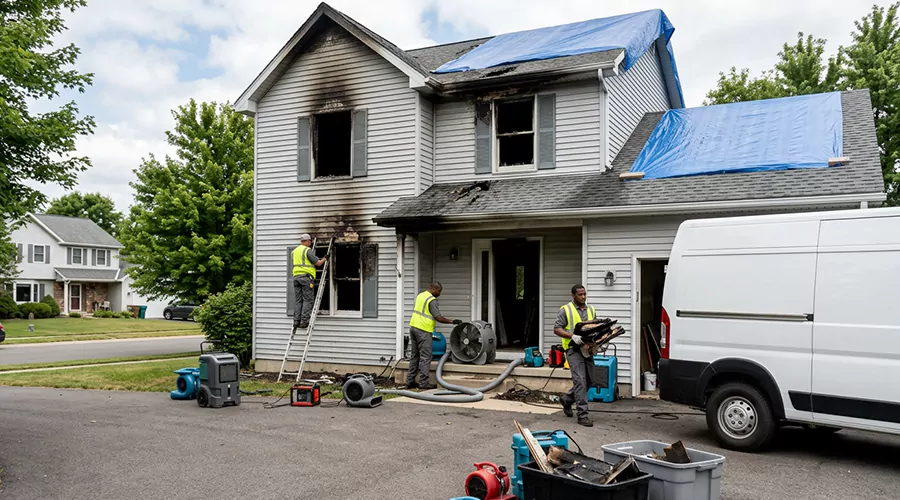
Fire damage restoration includes at least seven major stages, from securing the property and removing debris to smoke cleaning, odor treatment, drying, and final repairs. In 2026, a typical residential project costs about $8,000 to $18,000, although a small contained fire can cost much less.
The flames are only one part of the damage. Smoke can travel into rooms that never burned, while soot can settle on walls and belongings. Water used during firefighting can also soak floors and wall cavities.
A complete response must address each type of damage in the right order. Cleaning visible burn marks alone can leave hidden moisture or persistent smoke odor behind.
What Does the Fire Restoration Process Include?
Fire restoration starts with assessing the property and identifying every area affected by heat or smoke. Water used to extinguish the fire must also be considered. The damaged structure is then cleaned and dried before permanent repairs begin. Each stage prepares the property for the work that follows.
A typical process includes:
- Property safety assessment
- Emergency stabilization
- Damage inspection and documentation
- Water extraction and structural drying
- Burned material and debris removal
- Smoke and soot cleaning
- Odor treatment
- Contents cleaning and evaluation
- Structural repairs and reconstruction
The amount of work depends on the size of the fire. A small kitchen fire may leave heavy residue without causing major structural damage.
A larger loss can affect framing or electrical systems. In those cases, fire damage repair becomes a larger part of the overall recovery.
Why Is the Property Secured Before Cleanup Starts?
A fire-damaged building may have broken windows or roof openings that allow weather into the structure. Doors can also become damaged during emergency response. Securing open areas reduces additional exposure while the property is being inspected. Structural safety must be established before normal cleanup begins.
Temporary stabilization can include:
- Covering damaged roof sections
- Securing broken windows
- Restricting access to unsafe rooms
- Protecting unaffected areas from debris
- Identifying unstable ceilings or floors
Emergency fire restoration often begins with this type of stabilization because another storm or unauthorized entry can create new damage before cleanup starts.
Fire damage removal doesn't mean immediately tearing out everything that looks affected. Some materials may still be structurally sound and suitable for cleaning.
The first inspection helps separate items that can be restored from materials that must be removed.
Why Is Water Removal Part of Fire Restoration?
Firefighting can leave significant moisture inside a building even when the fire itself was limited to one area. Water can collect beneath flooring or enter drywall. Wet insulation can also hold moisture for days. Removing that water early reduces the chance of secondary moisture damage.
The drying stage can include:
- Removing standing water
- Extracting moisture from carpet
- Checking flooring and subfloors
- Measuring moisture inside walls
- Running air-moving equipment
- Lowering indoor humidity with dehumidification
Drying should begin quickly when building materials become wet. Materials that stay damp for 24 to 48 hours can create conditions where mold begins developing.
Water can also change what is salvageable. A cabinet that survived the flames may still swell after absorbing water used to extinguish the fire.
This is why fire and smoke damage restoration often includes a water-damage phase before detailed cleaning begins.
How Are Burned Materials and Debris Removed?
Damaged materials are removed after the affected areas have been inspected and the building is safe to work in. Severely charred drywall or insulation usually can't remain in place. Removing unsalvageable material also exposes hidden areas where smoke residue or moisture may still be present.
Common materials that may need removal include:
- Severely burned drywall
- Charred insulation
- Melted flooring
- Damaged ceiling materials
- Unsalvageable cabinets
- Heat-damaged trim
- Destroyed household contents
Fire damage clean up should be selective rather than automatic. Removing more material than necessary increases reconstruction work.
However, leaving heavily damaged material in place can cause another problem. Burned porous surfaces can hold smoke odor long after visible debris has been cleared.
Home fire cleanup therefore involves deciding what can be cleaned and what has reached the point where replacement makes more sense.
How Are Smoke and Soot Removed?
Smoke and soot require separate cleaning because residue can spread well beyond the room where the fire started. Fine particles settle on ceilings or furniture. Residue can also enter small gaps and porous materials. Cleaning methods must match the type of residue and the surface underneath it.
Smoke damage cleaning can involve HEPA vacuuming or dry surface cleaning before any wet method is considered. Applying the wrong liquid cleaner too early can smear certain residues deeper into a surface.
Fire soot removal may include treatment of:
- Walls and ceilings
- Hard flooring
- Cabinets and counters
- Furniture surfaces
- Windows and glass
- Metal fixtures
- Decorative items
Soot damage is not always dry and powdery. Grease fires can create sticky residue that behaves differently from the lighter residue left by some wood or paper fires.
Fire damage cleaning therefore depends on what burned. The same cleaning method should not automatically be used throughout the entire property.
Smoke damage on walls can also extend farther than the visible dark area. Light residue may cover adjoining surfaces even when there is no obvious staining.
How Is Smoke Odor Removed?
Smoke odor treatment works best after the materials producing the odor have been cleaned or removed. Air fresheners can temporarily change the smell without solving the source. Effective smoke remediation focuses on contaminated surfaces or belongings that continue releasing odor into the indoor air.
The first steps normally focus on source removal:
- Remove heavily burned debris.
- Clean soot from affected surfaces.
- Wash or treat salvageable fabrics.
- Replace materials that can't be cleaned.
- Check concealed spaces for trapped residue.
- Inspect HVAC components when contamination is suspected.
More advanced odor treatments may be considered after source cleaning. Methods can include thermal fogging or other deodorization procedures selected for the specific property.
Fire damage smoke odor removal is different from masking the smell with fragrance. A persistent odor usually indicates that smoke residue remains somewhere in the building.
Smoke damage smell removal may also require attention to porous materials such as upholstery or unfinished wood. These surfaces can absorb odor even when they show little visible residue.
Can Smoke Reach Rooms That Were Never Burned?
Yes. Smoke can travel through doorways and small openings before settling in parts of the building that were never touched by flames. Heating or cooling airflow can also help distribute fine particles. This explains why inspection often extends well beyond the visibly burned room.
Smoke damage from fire can appear as:
- Gray or black film on surfaces
- Yellow or brown discoloration
- Persistent burned odor
- Residue around vents
- Dark marks above door openings
- Soot inside cabinets
- Odor trapped in fabrics
- Film on windows or mirrors
Smoke damage in home interiors can therefore be much wider than the burn area. A kitchen fire may leave noticeable residue in a hallway or nearby bedrooms.
Smoke damage remediation examines these connected spaces instead of treating only the room where flames were visible.
The useful rule is simple. The edge of the burn mark is rarely the exact edge of smoke exposure.
What Happens to Furniture and Other Belongings?
Household belongings are evaluated according to heat exposure and the amount of smoke contamination. Some hard items can be cleaned while heavily burned objects must be discarded. Porous belongings require closer evaluation because odor and residue can move deeper than the visible surface.
Items commonly evaluated include:
- Furniture
- Clothing
- Curtains and linens
- Electronics
- Books
- Kitchenware
- Decorative items
- Documents and photographs
Smoke and soot removal from contents uses different methods depending on the material. A wooden table cannot be treated the same way as an electronic device or fabric chair.
Items that can be saved may be cleaned away from the main work area. This prevents finished belongings from being exposed again while structural cleanup continues.
Electronics deserve extra caution because soot can enter internal components. Turning on contaminated electronics before they have been evaluated can cause additional damage.
The goal isn't to save every object. The goal is to determine which items can be returned to usable condition without creating unnecessary risk.
How Long Does Fire Damage Recovery Take?
The timeline depends mainly on the amount of structural damage and how far smoke or water traveled. A small contained incident may need only a few days of cleaning. Minor repairs can extend the process to several weeks. Major rebuilding after a severe fire can take many months.
A general timeline looks like this:
| Stage | Typical Time |
|---|---|
| Initial assessment and stabilization | Same day to 2 days |
| Water removal and initial drying | About 1 to 3 days |
| Debris and soot cleanup | Several days to 2 weeks |
| Odor treatment and contents work | Several days or longer |
| Minor building repairs | About 1 to 2 weeks |
| Major structural reconstruction | Several months |
| Extensive rebuilding | 6 to 12 months or longer |
These ranges aren't fixed. Permit approvals and insurance decisions can add time even after physical cleanup is complete.
Fire damage recovery also slows when several types of damage overlap. A room with structural damage plus heavy soot needs more work than a room affected only by light smoke.
The cleanup phase shouldn't be rushed just to begin reconstruction. New finishes placed over unresolved odor or moisture can hide the problem instead of correcting it.
How Much Does Fire Damage Restoration Cost in 2026?
Fire damage restoration cost averages about $8,000 to $18,000 for many residential projects in 2026. Current national estimates place basic pricing near $4 to $7 per square foot. Actual totals can rise sharply when structural rebuilding or extensive contents replacement becomes necessary.
Common restoration components fall into different cost ranges.
| Restoration Component | Typical 2026 Cost |
|---|---|
| Smoke and soot removal | $500 to $5,000 |
| Water removal and drying | $2,000 to $6,000 |
| Air duct cleaning | $300 to $1,000 |
| Thermal fogging | $200 to $600 per floor |
| Structural inspection | About $350 to $900 |
| Typical total restoration | About $8,000 to $18,000 |
Another 2026 national dataset shows a wider normal project range of roughly $3,083 to $52,031. The difference reflects how dramatically one fire can differ from another.
Fire and smoke damage clean up usually costs less when the flames stay contained and the structure remains intact. Costs rise when heat damages framing or electrical components.
Fire and smoke damage repair can become the largest expense once major reconstruction is required. Smoke removal itself is often only one part of the final bill.
What Warning Signs Show Fire Damage Has Spread?
Damage has probably extended beyond the visibly burned area when smoke residue appears in adjoining rooms or odor remains after basic ventilation. Water stains can indicate another layer of damage from firefighting. Changes in flooring or electrical systems also deserve attention before a room is treated as restored.
Look for these warning signs:
- Soot appears around air vents.
- Smoke odor remains after the room has aired out.
- Walls develop gray or yellow film.
- Metal fixtures start discoloring.
- Flooring swells after firefighting water exposure.
- Drywall feels soft in areas away from the flames.
- Odor becomes stronger when the HVAC system runs.
- Black residue transfers to a clean cloth.
- Cabinets smell smoky inside when closed.
- Electrical outlets show heat damage.
- Ceiling material begins sagging.
- Smoke odor returns after surface cleaning.
Fire smoke damage cleanup becomes more involved when several of these signs appear across multiple rooms.
Fixing smoke damage also requires understanding how the residue moved. Cleaning one obvious wall won't solve contamination that has reached fabrics or air-handling components.
What Can You Safely Check Yourself After a Fire?
A homeowner should inspect only after emergency officials have cleared the property for reentry. The safest checks involve documentation and visible observations rather than aggressive cleaning. Heavy soot should not be disturbed casually because movement can spread fine residue across areas that were previously cleaner.
Once entry has been approved, you can:
- Photograph damaged rooms before moving items.
- Check adjoining rooms for visible residue.
- Look around vents for soot deposits.
- Note where smoke odor is strongest.
- Check for wet flooring after firefighting.
- Keep foot traffic through sooty areas low.
- Separate unaffected belongings when safe.
- Avoid operating damaged electrical devices.
Don't start soot clean up by scrubbing every surface with water. Some residue can smear or become harder to remove when the wrong cleaning method is used.
Avoid handling fragile items more than necessary. Soot can be transferred from your hands to materials that did not originally have visible residue.
The safest early goal is documentation and containment. Detailed cleaning can follow after the type and extent of the damage are understood.
When Should You Call a Professional?
Professional help is appropriate when structural materials are damaged or heavy soot covers multiple rooms. Contaminated HVAC components also require specialized attention. Water trapped inside floors or walls can create another reason to bring in trained help. Persistent odor after careful cleaning is another clear trigger.
Consider professional assessment when:
- Structural framing is burned or exposed.
- The roof has fire damage.
- Ceilings or floors appear unstable.
- Several rooms contain heavy soot.
- Smoke residue has entered the HVAC system.
- Firefighting water has soaked wall cavities.
- Electrical systems show heat damage.
- Smoke odor remains after surface cleaning.
- Large amounts of debris must be removed.
- Important contents need specialized cleaning.
- The property can't be safely occupied.
Fire damage remediation uses equipment and cleaning methods selected for different residue types. Moisture meters can also help locate water that isn't visible from the room.
Smoke damage repair may involve replacing materials that can't release the contamination they absorbed. Drywall or insulation can fall into this category after severe exposure.
Soot removal services can also address areas that are difficult to clean without spreading residue. This becomes more important when contamination has moved beyond the original fire room.
A trained assessment is particularly useful after a structural fire because the full scope isn't always visible on the first walk-through.
How Can You Prevent More Damage After the Fire?
Secondary damage can continue after the flames are out if soot is spread or water remains inside the property. The safest early actions focus on limiting movement and protecting unaffected belongings. Avoiding the wrong cleaning method can also prevent permanent staining on certain materials.
After the building has been cleared for safe entry:
- Limit movement through heavily sooted rooms.
- Avoid turning on a contaminated HVAC system.
- Move clean items away from affected areas when safe.
- Photograph belongings before disposal.
- Keep wet and dry items separated.
- Don't apply household cleaners without knowing the surface.
- Watch for new water stains over the next day.
- Keep damaged electrical equipment switched off.
Fire damage home recovery is easier when unaffected areas remain clean. Carrying soot through the building on shoes or clothing can expand the cleanup area.
Another useful step is to keep a written list of damaged materials and belongings. Photos taken before items are moved can make later decisions easier.
Conclusion
Fire damage restoration includes far more than removing burned debris. A complete recovery addresses water or soot before smoke odor and structural repairs are finished. The correct order helps prevent hidden damage from being covered by new materials. Heavy contamination or structural damage usually deserves professional assessment. This week, review your fire safety equipment and make sure every smoke alarm in your home works.
Frequently Asked Questions
Can smoke damage a room without flames entering it?
Yes. Smoke can travel through openings and airflow paths before settling on surfaces. Rooms far from the fire can still develop odor or residue.
Can you paint over smoke-stained walls?
Paint shouldn't be the first response to contaminated walls. Residue must be properly cleaned or sealed with the correct preparation before a finish coat is applied.
Are electronics safe after smoke exposure?
Not automatically. Fine soot can enter electronic equipment and affect internal parts. Avoid powering heavily exposed devices until their condition has been evaluated.
Should food be kept after a house fire?
Food exposed to heat or smoke may no longer be suitable for use. Sealed packaging doesn't always protect contents from extreme temperatures.
Does homeowners insurance usually cover fire restoration?
Many standard policies cover accidental fire damage subject to policy limits and deductibles. Coverage details depend on the cause of the fire and the individual policy.
Why does smoke odor return after cleaning?
Returning odor often means residue remains inside a porous material or concealed space. Odor treatment works best after the source material has been cleaned or removed.